The first time someone described me as a slow living type, I laughed.
I had spent most of my adult life sprinting. Sprinting through mornings. Sprinting through relationships. Sprinting through years I later realized I could not really remember. Slow was not something I had ever been. Slow was something I was afraid of.
Because if I slowed down, I might feel what I had been outrunning.
I think that is where the real story of slow living begins. Not with a linen apron. Not with a garden. Not with a beautifully plated bowl of oats. With a very ordinary human being deciding, quietly, that she is done being a stranger to her own days.
Slow living is not about doing less
I want to say this first, because the phrase gets mistaken so often.
Slow living is not about doing fewer things. Some of the most slow-living people I know have full, layered, demanding lives. What they have, and what I did not have for a long time, is a different relationship with the hours.
They are not trying to escape the hours. They are actually inside them.
That is the real shift. Not a lighter calendar. A deeper presence inside whatever the calendar is.
The pace is not the problem. The absence is.
For years I thought the problem was that I was busy. I would fantasize about the season when I would be less busy. I would tell myself, once this ends, I will slow down.
Something always came next. Life is like that. Something always comes next.
What I finally understood was that the pace was not really the problem. The problem was that I was not inside the pace. I was somewhere ahead of it, or somewhere behind it, or somewhere thinking about it. Almost never in it.
Slow living, in the end, is not about walking slower. It is about arriving where your feet already are.
What changed for me
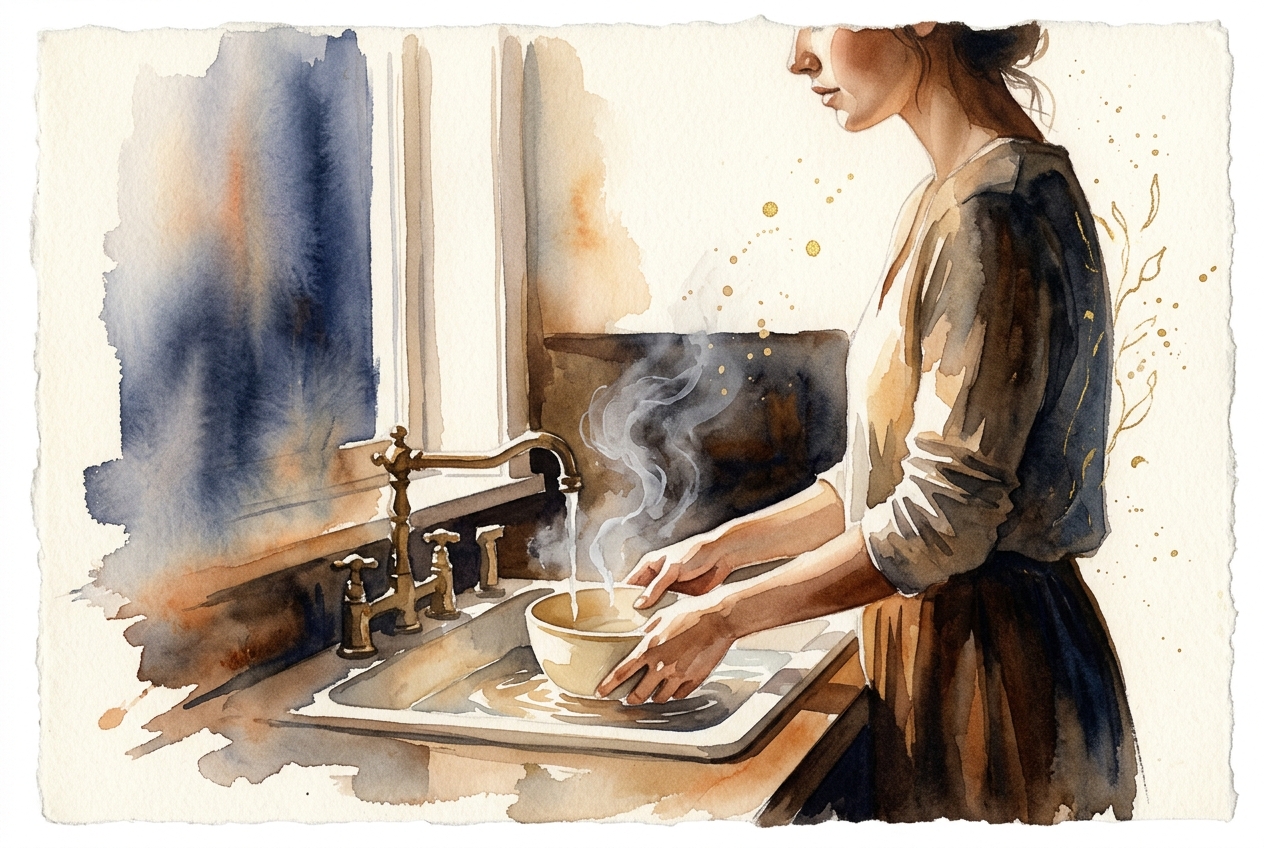
The moment I remember most clearly happened at a kitchen sink.
I was washing a bowl. I noticed, as if for the first time, that the water was warm. That the light was catching the edge of the plate on the counter. That someone I loved was speaking in the next room and I could hear the soft rhythm of their sentences even without listening for the words.
None of that was new. All of it had been happening, in every kitchen, at every sink, for years I had been too far away to notice.
I stood there and I cried a little. Not from sadness. From the strange grief of realizing how much life had been quietly happening without me.
That was the beginning.
Slow living gives you your ordinary hours back
Most of a human life is made of ordinary hours. Not the ceremonies. Not the milestones. The Tuesday afternoons. The waiting in line. The stirring of something in a pot. The walking to the mailbox. The five minutes before someone wakes up.
The average person, if they are lucky, gets about four thousand weeks. Most of those weeks are almost entirely ordinary hours.
If you are not present for those, you are not really present for your life. You are present for the highlight reel of your life. Which is a very different thing.
Slow living, at its heart, is the practice of belonging to the ordinary hours. Of taking them back from the future and the past and the endless middle-distance blur of productivity.
The small signs it is working
You know slow living is starting to take root, for you, when:
- You notice weather again. Not as inconvenience. As a companion.
- You linger a moment longer at the door before leaving a room someone you love is in.
- You do not immediately reach for your phone when you have to wait for something.
- You are less impressed by your own busyness.
- You do not need every experience to become content.
None of these are dramatic. All of them are the actual signs.
What it is not
Slow living is not an aesthetic. You can live very slowly in a small city apartment with a laptop and a mug. You can live very fast in a stone farmhouse with a garden and chickens.
Slow living is not a personality type. It is a practice. Available to anyone with a body and a breath and a willingness to stop running from the room they are already in.
Slow living is not a rejection of ambition. Some of the most quietly ambitious people I know are the slowest livers. Because they are actually inside their work. Because they know the difference between motion and progress. Because they can tell when a thing is done.
A soft invitation
If you have read this far and something in you has softened, even a little, I want you to know: you do not have to make slow living into another goal.
You do not have to schedule it, or optimize it, or announce it.
You can start by standing at your own sink for a moment longer than usual.
That is enough. That is the entire door.
The quiet power of slow living is not that it makes life bigger. It is that it lets you find out how full your life already is.